top of page

The Camp of the Saints: Part Two - A History of Violence

  • Ahmad J
  • Jul 8, 2025
  • 30 min read


History Rewritten 

Continuing with our analysis, this second part focuses on historic revisionism, the celebration and fetishization of violent periods of history, and the construction of Biblical parallels to provoke religious fear and paranoias of apocalypse. The constructions of history portrayed in Raspaill’s work are ones that we see consistently amongst the far-right, from idealizing the Crusades and its inherent violence, to the legitimations of colonialism and the subjugation of the Third World.  


Famine 

For instance, the Indian migrants are fleeing poverty, famine, and the “muck from its dried-up wells”. Raspaill presents this as something that is inherent to the Indian condition; while dismissing their cries of vengeance as the screams from a weak cuckold that allowed the imperialists to take their land, take their resources, and enslave their people.


India's histories of famine were a direct result of the British colonization of India. In fact, Calcutta, from which the fleet emerges, was initially a set of separate small villages prior to the arrival of the British East India Company – who itself, through Job Charnock, founded the modern city itself by merging the neighbouring villages of Gobindapur and Kalikata with Sutanati – a village where he had established a trading post beyond the reach of the Mughal Emperor. From here, he built Calcutta into a colonial stronghold independent of the local powers – and establishing British dominance in Bengal. This was a significant moment of transformation for the company’s ambitions in India.  

Saltpeter
Saltpeter


British interest in India came from its resources; from cotton, which was crucial to Britain's textile industry, to saltpeter – critical for the development of gunpowder. While the range of spices India offered tends to dominate the narrative of British imperialism in India, by establishing their dominance over India's saltpeter, the British had a monopoly over gunpowder production, leading them to become the leading nation with, as journalist and podcaster Robert Evans puts it, a “monopoly on shooting people”. 


Opium Poppy; credit Xinhua/Eyevine, The Economist

Opium, grown in India and exported to China, was crucial for Britain's schemes to leverage addiction as a political weapon during the Opium Wars. This ended with the ceding of Hong Kong over to the British, who developed it into a trading port independent of the Chinese - similar to the development of Calcutta.


Tea grown in regions like Darjeeling are central to British culture - yet the narrative is that Indians/Muslims cannot assimilate with Western culture.


Secondly, aside from modern Calcutta itself being a product of Britain, the history of famine in India is also intimately connected to the British – a fact that is widely accepted by historians today. Bengal alone suffered through 12 famines and 4 scarcities. The death toll is absolutely staggering, and the direct result of corporate ambition and free market economic policies geared towards profit – from exporting India's grain to Britain, to fixed taxes regardless of the state of the harvest, to laizzes faire economic practices that resulted in a complete absence of food relief. Remember, there was food available, but it was being diverted elsewhere. This is not a famine. It is a type of genocide, a type of holocaust.


picture from the Madras Famine


The first Bengal Famine of the 18th century which lasted roughly four years, resulted in the deaths of 10 million people under East India Company rule.


The Chalisa Famine, about 15 years later, killed 11 million people inside a single year.


The Doji Bara Famine, 10 years later, killed another 11 million people.  


Even after East India Company’s rule, these legacies were maintained by the British Crown, continuing into the modern era. In World War II, the British diverted India’s food produce to Britain, directly straining the local food supply resulting in a famine that killed an estimated 2.1-3.8 million. At the same time, 2.5 million Indians soldiers fought for the British during the war, a fact often overlooked. They were the largest volunteer force in the British army. Much of this ‘voluntary’ service was motivated by hunger, poverty and desperation. 


From an online photo archive titled The Unremembered: Indian Soldiers of World War II hosted by the Rhode Island University: “Some of these soldiers were swashbuckling young men who believed in “the cause.” Others joined out of poverty in search of a regular meal and salary, their hunger exacerbated by the famine (created by the British) that started in Bengal and spread to other parts of India.”   


Furthermore, local villagers had for many generations developed a system of agriculture to account for failed crops, droughts, and other naturally occurring threats to the harvest. They did this by each growing their own varieties of crops, rather than a select few. This protected villages, as if one crop failed, there was still chance for other crops to succeed.  


However, British imperial rationality required profit, this led the British to impose the production of particular crops in these villages. This introduced far greater risks to the food supply for these villages, making them much more vulnerable to famine. This is known as monoculturalism, and has other adverse impacts as well, particularly soil degradation, depleting nutrients from the soil.


Granary from Harappa, dating back to the ancient Indus Valley Civilization

Furthermore, in the worst case, villages would trade and supply one another in case one village had a poor yield. Granaries were maintained at both community levels and at household levels to store surplus grain for times of strain. Temples and monasteries further housed grain and oranized support schemes. Cultural systems, like the caste-based Jajmani system, provided a means of food distribution during difficult times.  


Lastly, the various powers that ruled India through the ages would themselves provide aid and administer civil and social services. These were administrative entities that both taxed and supported their people; during times of famine, taxes could be lowered, support could be provided, and grain prices could be adjusted. These provided buffers against the years of famine and scarcity that did occur prior to the colonial era. Yet, once the profit-minded economic policies of the East India Company came into play, the situation dramatically changed. Now India was simply a resource hub to be mined and milked efficiently and optimally. 


The Jewel in the Crown 

The British referred to India as the crown jewel of its empire (perhaps why the Koh-I-Noor diamond is kept by the British Royal Family till today), and for good reason too. India was 26-27% of the world's GDP prior to the colonial era in which the European powers invaded and fought each other over India; from the English, to the Dutch, the French, and the Portuguese – who were the first to establish a monopoly on trade with the East (Maddison, 2001).


Known as the Pompeii Lakshmi, an ivory statue of a Hindu goddess found in the ruins of Pompeii following the eruption of Mt Vesuvius, evidencing a relationship between India & Rome. credit wikipedia

Centuries prior to the colonial era, India was the world's only source of diamonds up until the discovery of diamonds in Africa and South America in the 18th century; records from Ancient Greece and Persia document diamonds from India. Roman writers and historians like Pliny the Elder write lamentably about the luxuries of India and how much Roman gold was drained to pay for it. This trade between Ancient Rome and Ancient India was one of the most prominent trade associations of the ancient world; Pliny alleges that the trade accounted for 100 million sesterces annually (difficult to calculate a value to compare with today's money, but this ranges somewhere between $1 billion to $5 billion in today's terms).


While this figure may be an exaggeration, according to historian and archaeologist Warwick Ball's Rome In The East (2000):


For example, just one documented consignment from Muziris (Chera kingdom, modern-day South India) to Alexandria consisted of 700-1,700 pounds of nard (an aromatic balsam), over 4,700 pounds of ivory and almost 790 pounds of textiles. This has been calculated as worth a total value of 131 talents, enough to purchase 2,400 acres of the best farmland in Egypt. When it is borne in mind that an average Roman cargo ship would have held about 150 such consignments, Pliny's figure becomes entirely plausible.


These histories and tales of the treasures of the East ignited ambitions for India and the spices and resources of the East during the colonial era. This quest for India led not only to the development of modern Calcutta, but much of the modern world.  


Christopher Colombus - the Genoese sailor funded by the Spanish crown (Isabella I of Castile & Ferdinand II of Aragon) - set out to dupe the Portuguese by finding his own routes to India, bypassing the Silk Road which passed through Muslim lands, and circumventing the Portuguese route around Africa – leading to his ‘discovery’ of the Americas. 


The Cape of Good Hope and the city of Cape Town was birthed from the colonial race to establish a passage to India. In fact, the ‘hope’ in Cape of Good Hope refers to the hope of passage to India. Originally, the Portuguese explorer Bartolomeu Dias named it “Cabo des Tormentas”, meaning “Cape of Storms”. However, King John II of Portugal (who Columbus initially approached to fund his expedition, but John II was already funding Bartolomeu Dias) changed the name to “Cape of Good Hope”, recognizing its strategic significance by promising a route to India and unlocking the East.  


From the spice islands to the cotton fields, these territories were contested over by all the European powers – while the locals were subjugated, exploited, enslaved, starved, and killed.  


India meant so much to Europe, that the contest not only birthed these towns and cities but also birthed modern espionage through the fight for Afghanistan. The British were concerned about Tsarist Russia expanding into Afghanistan from which they could lead an invasion into India - which was under British control. This led to a British-led invasion of Afghanistan which initially failed. Following this, the empire resorted to spycraft and espionage, deploying spies in the area to monitor for Russian activity. The Russians responded by sending spies of their own - leading to what the Russians named, 'The Tournament of Shadows', and what the British named, 'The Great Game'.


Dehumanizing through Disgust

Additionally, the Indus Valley Civilization, had one of the earliest known instances of public plumbing, as part of the local domestic infrastructure and not only for elites within the society. From underground drains that ran beneath streets (with ancient manhole covers evidencing maintenance activities), to flushable toilets in homes.  


I find it ridiculous to even be making this claim, but this challenges the construction of Indian culture as being inherently dirty. British colonial rule prioritized the extraction of profits and resources, this prioritized extractive infrastructure – ports and railways – over domestic and civil infrastructure like sanitation and public health.  


Additionally, the existing traditional sanitation infrastructure was not only neglected, but in some cases, dismantled. The lasting structural legacy of the colonial period saw India turn into one of the world’s sources for cheap labour and cheap manufacturing which accompanied rapid construction of industrial zones without proper public safety policies or any environmental safeguards. These zones also saw an abrupt growth in informal settlements which had no planning for waste disposal or sewage treatment. 


Indians are not a monolith either, with varying cultures within Indian-dom. Raspaill would seem to, at some disgusting level, understand this, as he mentions that some are Muslim whereas others are Hindu or Sikh. Yet even here, how he mentions these elements each portray their own subhuman characterizations. Early in the book, we are given the example of a Sikh character working as a guard for the Belgian Consulate. Often referred to as the “tame Sikh”, even though he is loyal to the Belgians and their cause, he is equally dehumanized, reduced to a subservient and loyal lap dog. 


King Leopold

Speaking of the Belgian, it also painfully ironic that he never mentions King Leopold of Belgium when he discusses colonial histories, yet he chooses Belgium to launch the migrant scheme, while also featuring a Belgian character – Consul Himmans – as the first great martyr of the story who attempts to prevent the migrants from boarding the ships and departing Calcutta. Leopold’s barbarism resulted in the deaths of an estimated 12-15 million people.  


The policies of Leopold were so brutal that soldiers began using severed hands as currency; creating a macabre symbol of Leopold’s domination. These policies starved locals into servitude, or held children ransom to force the parents to work, either in rubber labour camps, or serving in Leopold’s private army, the Force Publique (who had to provide severed hands as proof they were not wasting ammunition hunting or on other activities – other than killing). Additionally, hands or even genitals were chopped off for failing to meet rubber quotas. These policies had intended side effects, like creating a black market for severed hands. For instance, hungry soldiers who went hunting for food would need to provide severed hands to account for the ammunition spent hunting. This control over ammunition ensured there was no possibility of revolt as there would be no ammunition stockpiles – despite these local soldiers having firearms.  


Leopold’s colonial ambitions resulted in the death of over 10 million people without ever setting foot in the Congo. None of these barbaric realities are mentioned in Raspaill’s accounts – just as these realities are ignored by the far-right. Even though they use history to glorify their ideologies, they fetishize these periods and indulge in a sense of loss when contemplating the Fall of Constantinople and the losses of the Crusades – yet they conveniently ignore the structural consequences of colonialism which is much more recent history.  


A History of Violence 

The book lauds past eras of violence against non-white populations – even naming a central character after the Byzantine general who made the last stand of Christian Constantinople against the oncoming Ottomans – Constantine Dragases.  


The very first character we are presented with, Calghes, a French professor of literature (possibly a stand-in for Raspaill himself), praises the past history of violence against other races – right before murdering a white youth who was in support of the incoming fleet (Raspaill presents the youth as a radical, who rejected both his family and community in favour of seeing the migrant fleet take their revenge against the West).  


I’ve always led a rather quiet life. A professor of literature who loved his work, that’s all. No war ever called me to serve, and, frankly, the spectacle of pointless butchery makes me ill. I wouldn’t have made a very good soldier, I’m afraid.  


Still, had I been with Actius, once upon a time, I think I would have reveled in killing my share of Hun. And with the likes of Charles Martel, and Godfrey of Bouillon, and Baldwin the Leper, I’m sure I would have shown a certain zeal in poking my blade through Arab flesh. I might have fallen before Byzantium, fighting by Constantine Dragasés’s side. But God, what a horde of Turks I would have cut down before I gasped my last!  


Besides, when a man is convinced of his cause, he doesn’t die quite so easily! See, there I am, springing back to life in the ranks of the Teutons, hacking the Slav to shreds.  


And there, leaving Rhodes with Villiers de l’Isle-Adam and his peerless little band, my white cloak blazoned with the cross, my sword dripping blood.  


Then sailing with Don Juan of Austria, off to even the score at Lepanto. Ah, what a splendid slaughter! . . . But soon there’s nothing left for me to do. A few trifling skirmishes now and again, none of them too well thought of these days. Like the War Between the States, when my side is defeated and I join the Ku Klux Klan to murder myself some blacks. A nasty business, I admit. Not quite so bad with Kitchener, though, skewering the Mahdi’s Moslem fanatics, spilling their guts. . . .  


But the rest is all current events, a sad little joke. Most of it has already slipped my mind. Perhaps I’ve done my bit, killing a pinch of Oriental at the Berlin gates. A dash of Vietcong here, of Mau Mau there. A touch of Algerian rebel to boot. At worst, some leftist or other, finished off in a police van, or some vicious Black Panther. 


Famous painting of Charles Martell at the Battle of Tours where he defeated the oncoming Muslim army

This fetishization of historical periods like the Crusades, or Charles Martell’s stand against Arab expansion, are popular amongst the far-right today. His highlighting of Godfrey de Buillon and Baldwin IV aka Baldwin the Leper, recalls the Crusading era which spanned many centuries – though Raspaill, like many on the far-right – only counts select individuals and select instances from hundreds and hundreds of years of crusading. Forgotten from these accounts are the “People’s Crusade” (which is truly the first crusade) which resulted in the first pogroms of Jewish communities in Europe and instances of mass cannibalism – in which the entire town of Ma’arat was eaten. Forgotten from these accounts are the many defeats and mishaps of the numerous failed crusades that followed.  


Similarly, absent from these accounts are the cultural mixing between the West and the East that the crusades created – a fact which supremacists hate. This mixing not only led to the development of relations between the two worlds, but opened up lines of trade, migration, and cultural exchange as technologies and knowledges from the East were transmitted into the West. From spices like nutmeg to textiles like cotton, as well as sugar and lemons. From technologies and knowledges like Arabic numerals (which replaced the Roman numerals used in Europe and are the basis for the numbers we use today), the compass, medical sciences and works of Greek philosophers – preserved and translated by Muslim scholars – all of which collectively had a significant impact on the European renaissance.  

Godfrey de Buillon; a hero of the First Crusade, conquered Jerusalem from the Muslims and became the first "Crusader King" (he did not take the formal title of King as he believed the true King of Jerusalem was Jesus Christ)


These ‘histories’ put forth by Raspaill and others completely ignore these exchanges between East and West in favour of curating a narrative supportive of their agendas. Islam being incompatible with Western civilization is a popular narrative amongst the right – not just the far-right, but even the centre-right and to a serious extent, the centre-left as well. Islam helped to build Western civilization as it exists today – from toothpaste to algorithms, from ice cream to algebra.   


Both Brenton Tarrant and Anders Brevik considered themselves members of the Crusading order of the Templar Knights, who were founded to combat non-believers and maintain Christian control over the Holy Lands. Incidentally, the Templar’s first strongholds was in Gaza, and their headquarters was at the Al Aqsa Mosque (Jones, 2017). Worryingly, these Crusader discourses and Tarrant and Brevik’s identification with the Templars is not only espoused by them, but by the online communities that hero-worship them. For a radical racist to declare themselves a Templar is not alarming in and of itself – but for online communities of many thousands to confirm them as Templars and Saints is certainly far more alarming. These communities can be found on anonymous echo chambers in across the many chan-sites, to mainstream social networks like Facebook, and even to Pinterest and DeviantArt, where artwork featuring these killers are available to be sold.  

Image of Brenton Tarrant being canonized as a Saint, with Adolf Hitler and Dylann Roof - the Charleston Church Killer. From "Saints Culture" by Zoe Manzi


The Siege of Constantinople, by Palma il Giovane

The fall of Constantinople is another moment that is routinely fetishized in these Islamophobic histories; it represents a final stand against the invading Muslims which is glorified and romanticized amongst the far-right and white Christian nationalists/supremacists. This history completely disregards the Fourth Crusade, which resulted in the sacking of Constantinople by European Christian Crusaders. This was the first time Constantinople’s defences had been breached; it had seen off numerous previous attempts by emerging Muslim powers in the territory.


The Fourth Crusade critically wounded and weakened the great city, resulting in many being forced to flee while the seat of emperor was passed around by many. Many historians regard the Fourth Crusade as establishing the conditions for the eventual Ottoman capture of the city – a crucial point that the revisionist history of the right leaves out. The city’s infrastructure was devastated as its surrounding political territory was carved up to create new Crusader states. The economic collapse diminished the city’s ability to defend itself.  


This sentimental longing for the eras of violence leads us to the next theme: violence


Violence as the Solution 

The lack of empathy combined with the justifications provided by these ideologies of inherent superiority and these constructions of history provide legitimation for acts of violence to control or eliminate these populations. Raspaill’s book, from the very start, glorifies violence against these ‘subhuman’ populations; as is the case with his lengthy extolling of historical violence against non-Christians and non-whites.  


This same attitude towards violence is pervasive amongst far-right interpretations of culture wars and clashes of civilizations, where violence, genocide and ethnic cleansing is seen as the solution – as was the case with Hitler’s “ultimate solution”. 


Mencius Moldbug - real name, Curtis Yarvin. image credit: wikipedia

Curtis Yarvin, aka Mencius Moldbug, the thought-leader behind the Dark Enlightenment ideologies followed by figures like Palantir's Pieter Thiel, Vice President JD Vance, and the minds behind project 2025, has repeatedly cited similar race-based pseudosciences to justify the history of slavery. Similarly, the book’s attitude towards violence against other races, as well as its attitudes towards left-wing sympathies for other races, were both mirrored in Moldbug’s now notorious piece on Anders Brevik – the Oslo Bomber and Camp Utoya Killer. Brevik’s rampage deliberately targeted left-wing liberal democrats – rather than deliberately targeting migrants and Muslims. It was these figures that were responsible for the immigration crisis. In the book, these left-wing individuals are seen as cucks of the other races, stooges to be used and manipulated – until the moment the other races achieve critical mass and are able to invade and outnumber.  


Moldbug also wrote a eulogy for Ian Smith, the last prime minister of Rhodesia, acknowledging him as the last true Englishman capable of marrying political discourse with the necessary acts of violence required. This is the situation the book tries to describe. A political situation necessitating violence rather than simply political discourse and inaction. 


Renaud Camus, the architect of The Great Replacement Theory, sought to distance himself from the acts of violence committed in the name of his theory; similarly, Bat Yeor criticized Brevik’s violence and attempted to distance herself from him after Brevik cited her directly in his manifesto. Yet, figures like Yarvin had something different to say. Writing as Moldbug, Yarvin praised Brevik for “at least” knowing that the right people to target were the left-wing Europeans and not foreigners and migrants themselves. Yarvin did criticise the violence of Brevik, but, he criticized it as not being enough. It was not enough to end the left and establish right-wing rule. In this, Yarvin’s position very much parallels that of the book’s. An embracing of violence targeted at left-wing Europeans showing empathy for previously colonized peoples, cucked by the empathy and compassion provoked by the history of colonialism.   


The victims of Anders Brevik, mostly white Europeans. Brevik's manifesto makes clear who he sees as his enemy and who his targets are. Their murders should never be forgotten.


Disgust & Revulsion 

*Content Warning: The following passage is extreme in its depictions and is not for sensitive readers. 


Image from the Madras Famine; credit: unbelievable facts


These Indians are described in the most graphic and disgusting manner, reflecting much of the stereotypes of Indians and of brown people in general. Raspail’s vision of Indian migrants sees them as savage, sex-crazed, and filthy. In an early passage portraying the cultural behaviour of the Indians, adults and children engage in a regular orgy, with semen and feces oozing through the mass of bodies, old and young, firm and infirm. 


I am trying to portray the sense of disgust and revulsion I feel when reading these descriptions. Their graphic nature signifies intense disgust, provoking visceral responses to these stimuli. These people are constructed as savage and filthy creatures, coming to spoil a Europe that is clean and pure. This reflects the constructions of skin colour amongst white nationalist groups and neo-Nazis, who consider non-white skin colour as something that spreads, whereas whiteness represents purity – something at risk of running out, of being tainted and corrupted.  


This tendency is even reflected in mainstream cultural values. For example, Barack Obama is biracial, he is considered the first black President – but not the 43rd white President, or the first biracial president. Being half black is enough to be black, but being half white is not enough to be white.  


This impure nature of the Indians, forever at conflict with the purity of the West, is driven home in an early scene which stimulates an emotional and affective response to the vile and visceral depictions. These passages essentially serve to characterize the villain of the story; the coming apocalypse of Gog and Magog upon the Camp of the Saints.  


After spending much of their fuel and firewood cooking rice (another stereotype), the migrant fleet runs out of fuel on the French coast. Their solution: to collect fecal matter, dry it out, and make firewood to cook rice. Using powerful reactions and emotions like disgust and visceral revulsion is a powerful way of confirming an existing perception, or cementing a new perspective, in the mind of the reader. 


For the rice, no problem, no need to be told. There was only one solution. Every Indian knew it well. With no cow droppings at hand, our seagoing horde would have to burn its own, prepared by a tried and true peasant technique known for three thousand years. And so, the decks became weird workshops, where hands deft at molding this curious coal—children, for the most part, down on their haunches—took each new batch of turds, kneaded and shaped them, pressing out the liquid, and rolling them out into little round briquettes, like the kind we used to burn in our stoves not very long ago. The tropical sun did the rest, heating the sheet-metal decks, where the crowd had left great spaces, like giant drying racks, with thousands of the putrid mounds spread out to bake and harden into fuel.  


Other children, quick and clever, kept them supplied, eyes peeled for anyone, man or woman, poised in the humanoid fecal position. Zip! zip! There they were, hands flashing between two outspread thighs, grabbing the precious substance and trotting it off to the dung rollers while it was hot … All of which explains how the fleet kept cooking its rice, and why it spread the horrible stench our reporter friend mentioned (and which, by the way, caused many a head to be scratched on certain foreign vessels miles downwind). 


Secondly, the depiction continues to portray the hypersexuality of the Indians, a direct product of their cultural inheritance which Raspaill explains as a culture and a people for whom “sex was not a sin” – both young and old, man and woman, all engage in an orgy. 


Only the children, the turd runners—darting, dashing, hands cupped, in and out—gave any signs of life in that stagnant throng, lying on deck like battlefield corpses laid out at day’s end. But in time, very slowly, the flesh began to seethe. Perhaps it was the heat, the inertia. Perhaps the sun, pouring druglike against the skin and into the brain, or that tide of mystical fervor it swam in. Most of all, the natural drive of a people who never found sex to be sin.  


And little by little, the mass began to move. Imperceptibly at first. Then more and more, in every direction … Soon the decks came to look like those temple friezes so highly prized by tourists, prurient or prudish, but rarely touched by the beauty of the sculpture and the grace of the pose. And everywhere, a mass of hands and mouths, of phalluses and rumps. White tunics billowing over fondling, exploring fingers. Young boys, passed from hand to hand. Young girls, barely ripe, lying together cheek to thigh, asleep in a languid maze of arms, and legs, and flowing hair, waking to the silent play of eager lips. Male organs mouthed to the hilt, tongues pointing their way into scabbards of flesh, men shooting their sperm into women’s nimble hands. Everywhere, rivers of sperm. Streaming over bodies, oozing between breasts, and buttocks, and thighs, and lips, and fingers. Bodies together, not in twos, but in threes, in fours, whole families of flesh gripped in gentle frenzies and subtle raptures. Men with women, men with men, women with women, men with children, children with each other, their slender fingers playing the eternal games of carnal pleasure. Fleshless old men reliving their long-lost vigor. And on every face, eyes closed, the same smile, calm and blissful. No sounds but the ocean breezes, the panting breaths, and, from time to time, a cry, a groan, a call to waken other sprawling figures and bring them into the communion of the flesh …  


And so, in a welter of dung and debauch—and hope as well—the Last Chance Armada pushed on toward the West. 


This disgusting passage is in the early part of a book that is a contemporary cult phenomenon today; one that is championed by politicians and thought-leaders, one that was a best seller in France in 2011 – a book in which “rivers of sperm” is a repeated metaphor used to describe migrants.   


This signifies the rhetoric of replacement, wherein immigrant populations reproduce at a rate far greater than local European populations, resulting in the replacement of white Europeans with immigrant populations. A “fact” hinged on the attitudes towards sex amongst these non-Christian cultures, wherein the dignity of the ‘superior’ race prevents them from competing in this race for reproduction. 


Renaud Camus, a fellow Frenchman like Raspaill, architectured a theory he called The Great Replacement Theory in 2011. Central to his thesis was the birth rate of immigrant populations in France contributing to the erasure of the white race. Camus’ thesis has been thoroughly debunked and considered a dangerous conspiracy theory; it was a direct motivation behind the Christchurch killings, the El Paso Shooter, the Poway Synagogue Shooter, the Tree of Life killings, and more.  

Message of support for immigrant communities in the aftermath of the Christchurch Killer; credit, Jorge Silva (Reuters)
Image from a memorial at the Tree of Life Synagogue killings


The White Liberal as the Greater Evil 

This connects with the violence against the white liberal condoned by the far-right. Criticism of the white liberal effectively casts them as the greater of the two evils; the incoming migrants are the result of the white liberal’s empathy, they are responsible for the crisis and for the coming doom of the West.


Raspaill criticizes their foolishness throughout the book – from their delusions of empathy, to their facilitating of migration, to their relinquishing of the control over their colonies. This theme of antagonism towards the white liberal is consistent with white supremacist discourses.  


The book even describes white-on-white murder as being a more dignified way to be murdered. From the deaths of the heroes at the hands of their white brethren, to the idea of killing their own fellow Europeans to save Europe. This logic resolves the contradiction of wanting to save the white race but by killing white people.  


Furthermore, the descriptions and narratives used to construct white liberalism and white empathy – as cucks, as race traitors – similarly seek to overwhelm this contradiction but by provoking anger and rage. This is not a new phenomenon. The British developed subhuman narratives about the Irish, effectively constructing them as non-whites, thus legitimating their subjugation and suffering under British colonial rule. The infamous Irish Potatoe Famine, as its known, was actually a genocide. Millions died - and millions more fled - as a result of British economic policies, just like the famines in India.  

Cartoons and other publications during the 1800's depicting Irish as being originally an African race making them distinctly different from other white Europeans, thus justifying their mistreatment and subjugation. From Ireland from One or two Neglected Points of View (1899)

Returning to the vilification of the white liberal, not only are these figures demonized, but they are recognized as a greater threat than the migrants themselves. Raspaill not only criticizes them throughout the novel, but their villain arc is complete where, at the very ending, they get their comeuppance, as these same individuals are trampled, murdered, raped, and enslaved by the incoming fleet.  


Ultimately, the white liberals are also punished for their foolishness and empathy as they meet their doom at the hands of those they try to save. The aggression of the migrants is characterised in a manner that is consistent with white supremacist beliefs – from their savage nature that prevents them from being reasoned with, to their hypersexual nature where rape is routine.  


And a few seconds later, he’s swept up in turn, carried off by the horde. Struggling to breathe. All around him, the press of sweaty, clammy bodies, elbows nudging madly in a frantic push forward, every man for himself, in a scramble to reach the streams of milk and honey, the rivers thick with fish, the fields fairly bursting with crops, growing wild for the taking … Hemmed in on all sides, he feels himself slipping, almost falling to the ground in a tangled maze of flailing black legs. 


from David Pilgrim's The Brute Caricature (2012), a gallery of racist propaganda

Similarly, the hypersexual nature makes rape a common theme in these dehumanizing portrayals - consistent with not only the dehumanization of Indians, but other races as well - like the portrayal of freed African slaves in the US forming rape gangs - a narrative used to justify lynchings by the KKK - or even the current fears of grooming gangs in the UK.


By Easter Monday Lydie had been raped—on her famous white sheets, we might add—and proceeded, not unwillingly, in those first chaotic days, to tag after a troop of energetic Hindus, who had taken her over in a kind of joint ownership, since she was very pretty, and her skin was very white.  


Later, when things (and people) began to settle, they had clamped her away in a studio of sorts, in Nice, with a number of other girls similarly treated. A guard fed them and opened the door to all comers. The enterprise was even given a name: the “White Female Practice and Experimentation Center.” But in time prostitution was outlawed. (No less legally, of course.) Historians tell us that it no longer filled a need, since white women soon lost all pride in their color, and with it, all resistance. Could that be. Etc.. Etc. 

Also from The Brute Caricature gallery; David Pilgrim (2012)


Those who survive are completely assimilated into the new population that has now taken over the West; but this assimilation leaves them without any political power, casting them as another caste of untouchables within Indian society. Writing retrospectively after the invasion of Europe by the migrants, the narrator explains:  


Today, in that area of France predominantly Indian in population, they form a new caste of untouchable pariahs, completely assimilated, yet wholly set apart. They have no influence. Their political weight is nil. To be sure, in the two ethnic groups new leaders have emerged who hold sway with glib talk about racial integration, and brotherhood, and such. But nobody really listens. No one wants to have to remember the masters and mentors from the opulent past. They’re just in the way. 


The narrator goes on to say that these white figures were only celebrated after their deaths, as martyrs and heroes of the revolution. 


A curious detail, though: when one of them dies, they bury him in style. Like all the forerunners of important revolutions. Take Lydie, for example. She was one of the first. When she died, they suddenly called to mind those white sheets hanging from the windows in welcome. And the schoolchildren, prodded and coaxed by their teachers, wept their eyes dry with floods of ignoble tears. The fact is that Lydie’s death was anything but heroic. She died in Nice, in a whorehouse for Hindus, disgusted with everything in general and herself in particular. At the time, each refugee quarter had its stock of white women, all free for the taking. And perfectly legal. (One of the new regime’s first laws, in fact. In order to “demythify” the white woman, as they put it.) 


Biblical Traditions & Historic Parallels 

Raspail named his book after a passage from the Bible (specifically, the Book of Revelations), in which Satan – freed from his imprisonment – collects the nations of Gog and Magog and directs them towards “the camp of the saints”, the world of Christendom. 


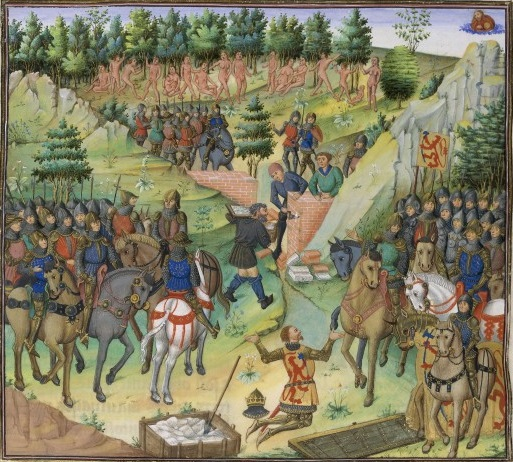
A painting from the 15th century depicting Alexander the Great walling off the peoples of Gog and Magog

In Raspail’s version, refugees from India, along with migrants and refugees from other previously colonized territories, represent the biblical threat of Gog and Magog pitched against Christian Europe and the West. This tradition, of using religious visions of the end times to characterize and demonize migration, has a long tradition in the Christian world which stretches back to the fall of Rome.  


According to James Palmer’s fascinating book, The Apocalypse in the Early Middle Ages (2014), these ideas of the end times were promised – by Jesus himself, by versions of scripture both canon and apocryphal. Yet, as Palmer puts it, “the End did not come soon enough, which led to repeated crises of interpretation” (Palmer, p.3, 2014). This resulted in a state of confusion, between the signs and promises of the end times, the changing dynamics of the empire and the world around it; from plague, to the emerging Germanic tribes and the fall of Western Rome.  


The ideologies of apocalypticism in the Roman Empire were in flux. Earlier interpretations, like that of Augustinian’s City of God, presented a spiritual and philosophical interpretation, wherein the end of the world was the result of God’s final judgment and Christ’s second coming – but not the result of the Roman empire collapsing, or any earthly catastrophes.  


This changed following the decline of Western Rome, when the apocalytpic ideas and promises began to have more tangible substance – from plagues to invasions. This led to an evolution in apocalyptical thinking hinged on two things: (i) one must not be passive in the face of the End Times promises; and (ii) the combination of the Roman Empire with the world of Christianity – ‘Christendom - as a means of establishing a collective mindset where the empire as a political entity was connected to the religious body. Threats to the empire were seen as threats to the faithful. Initial records in the early 6th century show distinctly different terminology for the Empire and the Church – they could co-exist, but the Empire and ‘Christendom’ were not one and the same. It is important to assess this type of thinking as it continues today; where ‘the West’ is regarded as Christendom, as ‘The Camp of the Saints’.   


St Gregory the Great; Brittanica

This change began with the Lombard invasion in 593, Pope Gregory (also known as St Gregory the Great) drew parallels between the Lombard invasion and the fulfillment of Biblical prophecies – without regarding the Lombards as End Times figures like Gog and Magog (as many were Arian Christians whom Gregory would later attempt to Catholicize) (Palmer, 2014).  Gregory’s preaching spoke of a religious orientation that combined theology and religiosity with practical politics of action; reminding people to “take responsibility for the fate of their souls” (Palmer, p.59. 2014).  


This was a powerful and empowering message, one which effectively stated that believers should not abandon hope in the face of the fulfillment of End Times promises, but should endeavor to endure, to govern themselves responsibly and patiently, rather than passively await the promised doom. As Gregory saw it, “this meant action was needed: there was to be no reward or excuse for being unprepared” (Palmer, p.60. 2014).  


Historia Francorum; wikipedia

Gregory of Tours (a second Gregory) who was bishop of Tours, a city in what is now central France, wrote in the same period as Gregory the Great and bore many influences of Gregory the Great’s writings: he encouraged activity over passivity, and in his renowned works – Historia Francorum (History of the Franks) – he highlighted the role individual morality and individual eschatologies within the collective context. Gregory of Tours wrote considerably about apocalyptic interpretations and his works contained several narratives of ‘pseudo-Christs’ and antichrists – messianic figures claiming to be Jesus returned. The world these figures emerged out of was one known for its considerable social turmoil, from invasions to plague, contributing to an unstable social climate combined with these figures preaching “utopian hope” to the people.  


Even the not-so-recent reconquest of Rome by the Eastern Empire from the Ostrogoths added to this sense of hope amidst an environment of tension. While simultaneously casting the borders and boundaries of the Roman Empire within a religious context. The fall of Western Rome did not result in the collapse of the Christian institutions within. In Historia Francorum, Gregory presents a biblical history then moves on to a Roman and then Frankish history – establishing Frankish Christianity within a religous and spiritual legacy. Thus, the conversion of the Franks saw them inherit the spiritual mission of Rome – to spread Christianity. Previous Roman provinces, like Gaul and Hispania, were now Christian domains – these were contrasted with territories beyond the old Roman borders, which were still mostly pagan.  


Gregory of Tour’s writings had a lasting impact, importantly, they influenced the apocalyptic traditions that followed: seeing history as a spiritual drama, a conflict of esoteric and divine forces, rather than simply clashes between differing peoples and differing cultures.  


Thus, while Gregory of Tours did not write of a specific apocalypse, his influence left the doors open for a vigilant audience to assess their world and make apocalyptic interpretations. Fundamentally, this shift in ideology had two outcomes: (i) connecting the fate of Christendom to the fate of the Roman Empire; and (ii) encouraging a practical and pragmatic approach to the End Times, where individual citizens can take control of their fates rather than passively waiting for the End.  


The Apocalypse of Pseudo-Methodius 

As the Western Empire weakened and waned, these apocalyptic narratives were more widespread when compared to Eastern Rome, which enjoyed relative stability in comparison. This changed with the rise of Islam which occurred during the reign of Emperor Herakleios. Syria, Jerusalem and Egypt were all Roman provinces that were being fought over with the Persians, till they were ultimately lost to the Arabs who unseated both Roman and Persian powers in the region.  


The Expulsion of Hagar and Ishmael, by Adriaen van der Werff, c. 1699

This led to the development of similar apocalyptic thinking in Eastern Rome. A key piece of writing that emerged in this time was the Apocalypse of Pseudo-Methodius; an apocalyptic script that was written sometime after the rise of Islam in the 7th century. As the name suggests, it is a pseudo-apocalyptical text, meaning that it was incorrectly attributed to St Methodius of Olympus, a writer from the 4th century – several hundreds of years prior to the advent of Islam – making the text appear as a prophetic warning that foretold of Islam’s coming, which it describes as the “sons of Ishmael” which God sets upon the Christian Roman world as punishment for Christians losing faith and engaging in practices like apostacy or homosexuality.  


The work was so popular that it was translated from the Syriac into both Greek and Latin (as well as Coptic, Armenian and Slavonic) and widely published across the reaches of the West and East of Christendom (Palmer, 2014). “Apocalypticism had a new voice and one which would deeply influence medieval traditions” (Palmer, 2014. p. 108). From the rise of the Arabs, to the Mongol invasions, invoking Pseudo-Methodius was a means of making sense of these events within a spiritual context.  


The text is also responsible for the “Last Emperor” mythology; a staple of Christian eschatologies that have lasted till today, particularly the idea of a messianic ruler that rises to power towards the final days, prior to the coming of the antichrist.  


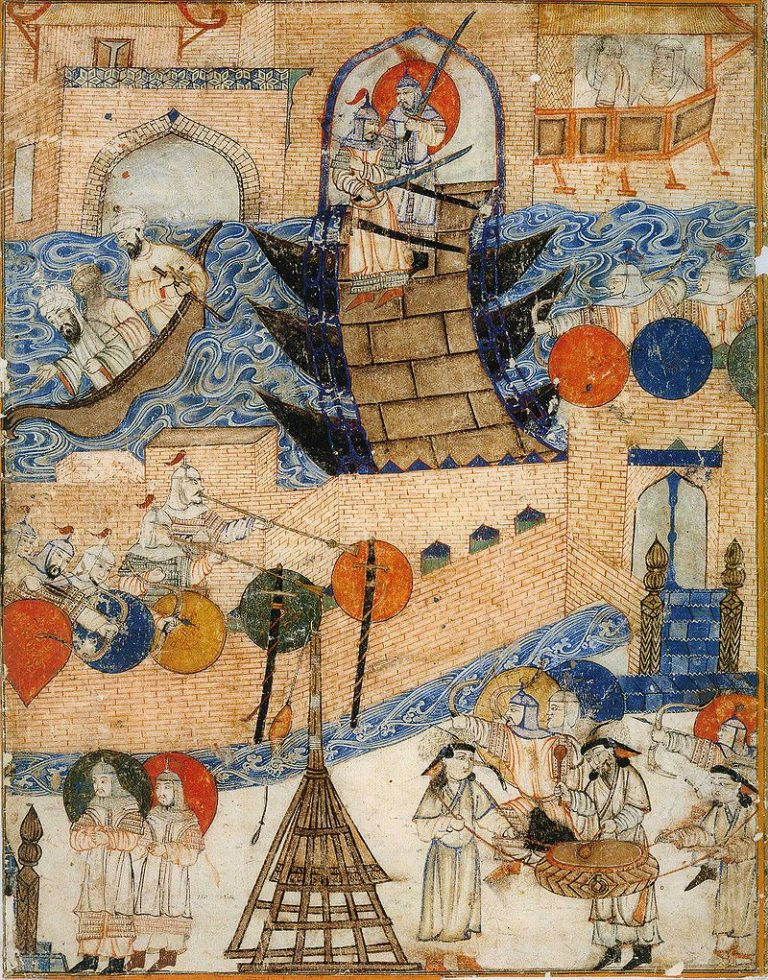
Siege of Baghdad by the Mongols, led by Hulegu Khan

Ironically, Gog and Magog are written about in the Quraan itself – known as Ya’juj and Ma’juj - and is an End Times vision shared by the Muslim world. This makes these figures as metaphors to describe Muslims quite shocking to Muslim audiences, while also making it quite laughable. At the same time, Islamic scholars, leaders, and kings, saw threats to their empire as the fulfillment of End Times promises. From the Turks who threatened Baghdad, to the Mongols who destroyed Bukhara and Samarkand, even the Vikings who appeared later.  


This metaphor – where Satan unleashes the armies of Gog and Magog – would also characterize the leftist liberals as being influenced by Satan, allowing the migration and invasion to occur. This is not far from the popular themes of Satanic conspiracies in politics today. Most of these conspiracies which claim particular politicians are Satanist, most often construct figures on the left side of the political divide rather than the right. 

QAnon is a widely believed and widely influential meta-conspiracy in contemporary social discourse and politics. It has a global footprint, including South Africa, Australia and more, and uses leftist Satanic conspiracies as one of its cornerstones. Accordingly, leftist democrats harvest the blood of young children in a Satanic ritual, requiring child-trafficking operations and complex political maneuvers to facilitate and conceal. Donald Trump is seen as a messianic figure, prophesized to bring an end to the reign of the Satanic leftist pedophiles, who control the liberal media and rigged the 2020 election. QAnon was central in actuating the violence of January 6th.  


To Sum Up All of this Hatred... 

While these two articles summarize and criticize The Camp of the Saints, they also serve as a deconstruction of central mythologies amongst the far-right. From stereotypes of immigrants, to justifications for colonialism and the legitimations of current trends in far-right politics – deportations, overt racism, Islamophobia and much more. For more information on those matters individually, I do want to develop pieces focusing solely on individual elements – like the Crusades, or the development of apocalyptic thought and how it feeds into the stereotypes that are popular today. 


This book was horrifying, revolting, and incredibly difficult to read. What made it even more challenging was the awareness that the book is so influential in society today, from world leaders recommending the book to their followers, to regular people reviewing and recommending the book online. The average comments section on any content related to the book is full of people (possibly bots) praising the book as prophetic, as a warning, and Raspaill as a warner and prophet – when he is really a bigot and racist who draws on fantasies and convenient histories that are inoffensive to his sensibilities.  


Following the release of The Camp of the Saints, another racist book – The Turner Diaries – would be published, becoming a darling of the Klu Klux Klan, and motivating terrorists like the Oklahoma City Bomber, Timothy Mcveigh, who committed the largest act of domestic terror in American history. The Turner Diaries begins with its version of the racial apocalypse fantasized within these ideologies; through diary entries of a white soldier after the apocalypse, it tells of the fight to take the white world back through acts of violence. More recently, films like 1990’s The March and books like 2015’s Submission have continued the trend; The March mirrors The Camp of the Saints except that it has Muslim migrants from Sudan invading France instead of migrants from India; Submission, a much more recent book (2015), became a best seller. It was about a Muslim political party in France that gets elected to power with the support of the Socialist party.  The book features actual figures from French politics – like Marine Le Pen – as key characters in the story.    


References


Ball, W. (2016) Rome in the East: The Transformation of an Empire. 2nd edn. London: Routledge. Available at: https://doi.org/10.4324/9781315646886


Dalrymple, W. (2019). The Anarchy: The Relentless Rise of the East India Company. London: Bloomsbury Publishing.  


Hochschild, A. (1998). King Leopold’s Ghost: A Story of Greed, Terror and Heroism in Colonial Africa. Boston: Houghton Mifflin.  


Jones, D. (2017). The Templars: The Rise and Fall of God’s Holy Warriors. London: Head of Zeus.  

Palmer, J.T. (2014). The Apocalypse in the Early Middle Ages. Cambridge: Cambridge University Press. 


Maddison, A. (2001). The World Economy: A Millennial Perspective. Paris: Organisation for Economic Co-operation and Development (OECD).


Pilgrim, D. (2012) The Brute Caricature. Ferris State University. Available at: https://www.ferris.edu/jimcrow/brute/


Pseudo-Methodius (2012). Apocalypse of Pseudo-Methodius: An Alexandrian World Chronicle. Translated by Garstad, B. Cambridge, MA: Harvard University Press.  


Raspail, J. (1975). The Camp of the Saints. Translated by Shapiro, N. New York: Scribner.  


University Libraries. (n.d.). The Unremembered: Indian Soldiers of World War II. [online] Digital Initiatives. 


Vintage News Daily. (2022). ‘The Hacked Hands of the Belgian Congo: Horrifying Photos of Mutilated Congolese People in the Congo Free State’, Vintage News Daily. Available at: https://vintagenewsdaily.com/the-hacked-hands-of-the-belgian-congo-horrifying-photos-of-mutilated-congolese-people-in-the-congo-free-state [Accessed 7 July 2025].

Comments


Top Stories

Subscribe to Our Newsletter

Thanks for submitting!

Democracy, Disinformation & Disaster

Please contact us with any questions, suggestions or feedback.

democracydisaster@gmail.com

bottom of page